
小专题:机器学习性能度量,从一般到特殊
通用性能评估
以下内容仅对二分类有效
Precision, Recall and R
对于任何机器学习所产出的结果,都可以列出下述列联表(分类结果的混淆矩阵)
| 预测为真 | 预测为假 | 总数 | |
|---|---|---|---|
| 事实为真 | True Positive | False Negative | TP+FN |
| 事实为假 | False Positive | True Negative | FP+TN |
| 总数 | TP+FP | FN+TN | N=TP+FN+FP+TN |
查准率 (准确率)
在所有预测为真的样本中,有多少是事实为真的。P越高说明不错
查全率 (召回率)
在所有事实为真的样本中,有多少被预测为真。R越高说明不漏
绘制P-R图像
我们通常通过得分(置信度)来判断分类。因此对得分排序,高者为“预测为真”,低者为“预测为假”。
排序时,升序降序均可,但前后需保持一致。
每个样本进入统计,得到列联表,计算P和R,从而画出P-R图像。
平衡点 Break-Even Point, BEP
显然的,不错和不漏相互制衡,即通常为负相关。当时为最naive的最优解。
度量
特别的,
其中 度量了R与P的相对重要性。以1为界, 越大查全率 影响越大,反之查准率 影响越大
特别的,
, 且越接近1表示两者平衡情况越好,学习的性能越好。
ROC与AUC
受试者工作特征 Receiver Operating Characteristic, ROC
真正例率 True Positive Rate
假正例率 False Positive Rate
ROC是以其分别为纵横坐标而成的图像
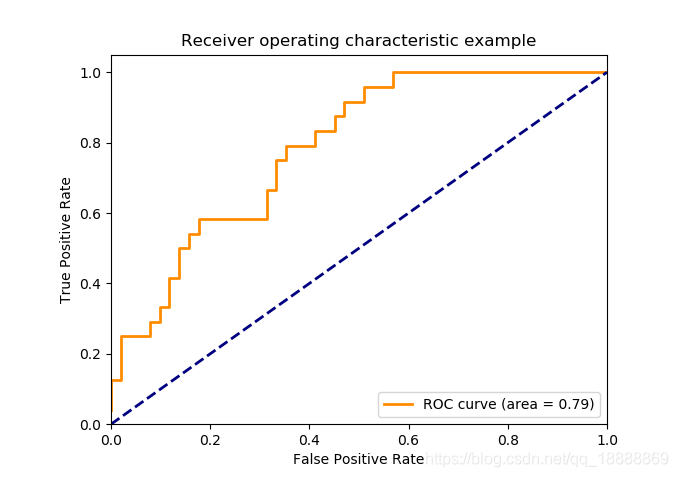
Area Under ROC Curve, AUC: 下部的面积。若拟和效果非常出众,TPR=1, FPR=0,面积应为1,因此AUC越大拟和效果越好。
特别的,给定个正例和个反例,与分别表示正例和反例集合,定义排序损失
FAR, FRR, EER
False Acceptance Rate假接收率,没病当有病
False Rejected Rate假拒绝率,有病当没病
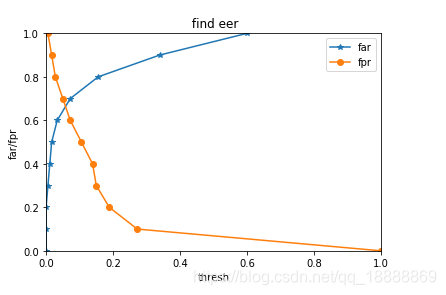
(这张图的标注有误,FAR=FPR,应该是FAR和FRR,且FAR是橙色的)
对分类问题来说,两个率都应当是越小越好,从而EER越小越好;但是对攻击类来说,越大说明攻击的越成功,相应的EER也是越大越好。
横坐标为threshold,是一组0-1之间的等差数列,作为识别模型的判别界限。图中两条图线的交点对应的横坐标即为EER。EER并没有实际意义,但是EER越低表示模型效果越好。在工程上,我们一般将EER与系统判别的threshold划等号,但对于threshold不是0-1的情况,也可能将threshold映射回到EER上。
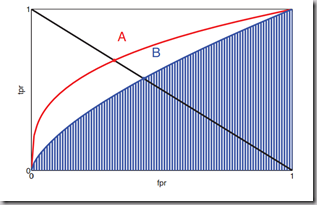
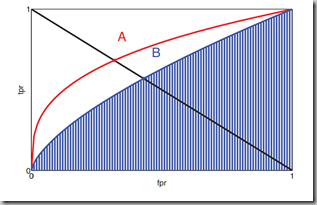
从另一个角度看,FAR-FRR交点等价于求解,换而言之,这是ROC曲线与的交点。
红线A与蓝线B分别表示了两个不同分类器的TPR-FPR曲线(即ROC曲线)。曲线上任意一点都对应了一个threshold 。该曲线具有如下特征:
- 一定经过 (1, 1),此时 FN=TN=0,全部“预测为真”,此时
- 一定经过 (0, 0),此时 TP=FP=0,没有“预测为真”的样本,此时
- 最完美的分类器(完全区分正负样本):(0, 1)点,即TPR=1, FPR=0,全部判断正确
- 曲线越向左上角凸起,分类效果越好,对应越小的
Code Implementation
def compute_det_curve(target_scores, nontarget_scores): #Detection Error Tradeoff
    '''
    Parameters:
    target_scores: y hat = 1
    nontarget_scores: y hat = 0
    '''

    n_scores = target_scores.size + nontarget_scores.size
    all_scores = np.concatenate((target_scores, nontarget_scores))
    labels = np.concatenate((np.ones(target_scores.size), np.zeros(nontarget_scores.size)))

    # Sort labels based on scores
    indices = np.argsort(all_scores, kind='mergesort')
    labels = labels[indices]

    # Compute false rejection and false acceptance rates
    tar_trial_sums = np.cumsum(labels)
    nontarget_trial_sums = nontarget_scores.size - (np.arange(1, n_scores + 1) - tar_trial_sums)

    # false rejection rates
    frr = np.concatenate((np.atleast_1d(0), tar_trial_sums / target_scores.size)) # 在最前面加一个0,FRR的初始值为0
    far = np.concatenate((np.atleast_1d(1), nontarget_trial_sums / nontarget_scores.size))  # false acceptance rates
    # Thresholds are the sorted scores
    thresholds = np.concatenate((np.atleast_1d(all_scores[indices[0]] - 0.001), all_scores[indices])) # 加入一个理想中的score,其他是对应的threshold
    # 这里的threshold (EER) 就是判断过程中的score,也就是二分类的threshold
    # threshold并不是直接意义上的横坐标,也是通过转换和对应关系得到的。
    # 虽然我觉得这里增加一项并不会影响结果

    return frr, far, thresholds


def compute_eer(target_scores, nontarget_scores):
    """ Returns equal error rate (EER) and the corresponding threshold. """
    frr, far, thresholds = compute_det_curve(target_scores, nontarget_scores)
    abs_diffs = np.abs(frr - far)
    min_index = np.argmin(abs_diffs)
    eer = np.mean((frr[min_index], far[min_index]))
    return eer, thresholds[min_index]
It's the code copied from AASIST
References
https://blog.csdn.net/qq_18888869/article/details/84848689
https://blog.csdn.net/qq_18888869/article/details/84942224
https://www.cnblogs.com/xfzhang/p/4788227.html
https://blog.csdn.net/qq_37977007/article/details/135736055